

The Best AI Language Learning Apps Revolutionizing Fluency in 2026
I remember my first real-world conversation attempt in a new language. My palms were sweaty, my mind raced through grammar rules, and the fear of stumbling over a basic verb paralyzed me. In that moment, I wasn’t worried about achieving perfect fluency;
I was worried about making one of those “funny” or “embarrassing” mistakes that would stop the words from flowing altogether. This fear—this psychological barrier—is the biggest challenge facing language learners today, especially immigrants trying to integrate socially.
Traditional methods and many older apps simply fail because they don’t provide the emotionally supportive, real-time practice needed to overcome that hurdle. But if you’re tired of rehearsing sentences in your head only to freeze when it counts, it’s time to look at how cutting-edge AI Language Learning Apps are transforming the game.
Table of Contents
Why Traditional Language Learning Fails (And How Adaptive AI Stepped In)
For years, language acquisition was confined to textbooks, pre-designed drills, or generic programs that gave everyone the same fixed course structure. These tools were adequate for memorizing lists, but they profoundly lacked the adaptive, personalized, and conversational depth that truly builds confidence.
The Psychological Barrier to Speaking
The root of the problem is psychological: the burden of being laughed at or misunderstood in real life limits motivation and bravery. When people struggle to communicate freely, they start avoiding unnecessary interactions, creating an integration challenge.
This is precisely where technology must step up. The promise of Adaptive AI is that it doesn’t just teach you content; it molds the experience to fit you, addressing cognitive, behavioral, and even affective (emotional) needs during the learning process.
Limitations of Fixed Curriculum Apps
Older language learning models provided a predetermined sequence of challenges and often offered uniform feedback regardless of the user’s individual differences, such as their learning style or emotional state.
Modern AI-enabled adaptive game-based language learning (AI-AGBLL), however, uses sophisticated techniques like Intelligent Agents and Natural Language Processing (NLP) to personalize the journey. This ensures you are never overwhelmed by content that is too difficult nor under-challenged by exercises that are too easy, keeping you firmly in the learning sweet spot.
You might want to read this: How AI Hallucinations Happen: A Step-by-Step Guide for Humans
The Core Mechanics: What Makes Modern AI Language Learning Apps Adaptive?
The power behind today’s best tools isn’t magic; it’s smart technology leveraging massive language models, often the caliber of GPT-4o, to facilitate dynamic and personalized interactions.
Leveraging Generative AI and NLP
At their core, these applications rely on key AI techniques:
- Intelligent Agents: These are often virtual tutors or characters (Non-Player Characters or NPCs) that can perform tasks autonomously, analyze your immediate actions, estimate your preferences, and engage you in discussions. In fact, intelligent agents were the most popular AI technique observed across recent studies on adaptive learning platforms.
- Natural Language Processing (NLP): NLP techniques are crucial for interpreting what you write or say, generating human-like conversations, and detecting and responding to linguistic properties. Sentiment analysis, for instance, can identify negative emotions like frustration or anxiety in text-based dialogues and prompt the AI to provide encouraging feedback.
- Data Mining: This technique helps provide a transparent decision-making process, allowing the AI to explain whyit made certain adaptations or content choices.
The Adaptive Learning Model in Practice
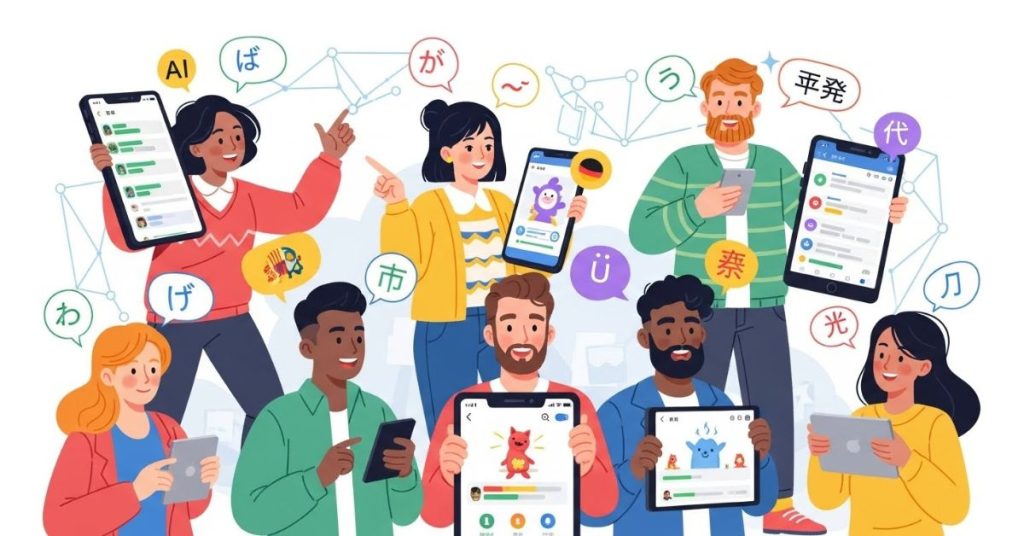
The goal is to deliver real-time, personalized support. The AI adjusts based on what it observes about your learning behavior.
Monitoring Parameters
The most frequently observed indicator for adaptation is your in-game performance (a cognitive parameter), which acts as a baseline to understand your language proficiency and adjust the material’s difficulty. However, the AI also pays close attention to how you behave:
- Time on Task: How long are you spending on a task?
- Help-Seeking Behavior: How often are you asking for hints or translations? This insight signals when the system should offer learning scaffolding.
Key Instructional Support Tools
Once the app identifies your need, it delivers customized support, with these features being the most prevalent in research:
- Adaptive Feedback/Prompts: These are suggestions, explanations for mistakes, or prompts for self-reflection that help you correct language errors and refine performance.
- Adaptive Language Contents: This involves adjusting the difficulty of texts, vocabulary, or tasks to match your current proficiency level, improving your sense of self-efficacy.
- Adaptive Dialogues: This allows NPCs to mimic human conversations, generating context-aware responses tailored to your skill level. For instance, the NPC might initially speak with grammar and vocabulary close to your level, or offer explanations if you seem to hesitate.
Beyond Flashcards: Top AI Language Learning Apps for Conversational Fluency
The current landscape of AI language learning apps is diverse, catering to everyone from absolute beginners to advanced users looking for hyper-personalized practice. A recent comparative review found certain apps excel in specific areas, especially conversation depth and customization.
Customization Kings: Heylama, Hablo, and Praktika
For serious learners who prioritize spoken fluency and flexible learning paths, customization is key. These apps offer superior conversational experiences:
1. Heylama: Advanced Practice & Flexibility
Heylama is optimized for intermediate to advanced learners, focusing strongly on conversation and flexibility.
- Conversational Depth: It enables real-life dialogues with an AI tutor (like “Anka AI”) that provides natural, native-accented speech and instant feedback.
- Ultimate Customization: You can create your own custom role-play games by defining characters and situations, and you can add your own custom words and vocabulary for review.
- Vocabulary Mastery: It uses a spaced repetition system to ensure long-term retention, analyzing your practice responses to suggest relevant missing vocabulary.
2. Hablo & Praktika: Structured Interaction
These apps combine free-flowing interaction with valuable structure, often ranking highly for their structured lesson flow.
- Hablo’s Custom Lessons: This app offers the remarkable ability to create a custom lesson on the fly about anytopic (e.g., painting a house), integrating role-play, fill-in-the-blank exercises, and sentence rearrangement challenges within the conversation.
- Praktika’s Feature Richness: Praktika feels like a highly mature app, offering rich features, multiple avatars (like the “Noob” character), and the option for a video call simulation. It offers good structure and helpful summaries at the end of lessons.
Foundational Builders: Duolingo and Babbel
If you are just starting out or prefer a highly structured approach developed by linguistic experts, these platforms are widely utilized.
- Duolingo: Ideal for absolute beginners and casual users due to its engaging, iconic gamification and entirely free basic tier. It uses spaced repetition very effectively for foundational vocabulary building. However, its conversation practice is limited to pre-set dialogues.
- Babbel: This app is designed by linguists and focuses heavily on real-life usage and cultural context, integrating grammar, vocabulary, and conversation exercises. It’s excellent for building a practical, well-rounded foundation but offers minimal flexibility for adding custom content.
Game On! How Gamified Learning and Simulation Build Confidence
Learning Methodology Showdown
Comparative impact of Traditional, Gamified, and Simulation-based learning.
| Core Metric | Traditional | Gamification | Simulation |
|---|---|---|---|
| Primary Focus | Information Delivery | Engagement & Motivation | Real-world Skill Application |
| Engagement Level | Passive | High | Very High |
| Retention Rate Avg. after 30 days |
10% | 60% | 90% |
| Best Application | Foundational Theory | Repetitive Tasks & Habits | Complex High-Risk Skills |
Why does gamification work so well? Because it taps into our natural desire for competition, challenge, and reward, making activities like repeated drill practice, which usually cause disengagement, fun instead.
The Power of RPG Simulation
One innovative approach utilizes an RPG (Role-Playing Game) format where players navigate a virtual city and interact solely with dynamic Non-Player Characters (NPCs). This system is explicitly designed to solve the two main problems facing newcomers: boosting conversational confidence and providing a low-pressure starting point for absolute beginners.
Since players know they are talking to an AI, the psychological burden of being judged is significantly reduced, allowing them to speak more freely.
Boosting Beginner Confidence with a Native Guide
A critical feature for absolute beginners is the personalized guide who follows the player.
- This guide can communicate in the player’s native language for clarification.
- Crucially, the guide gradually adjusts its own language level, shifting toward the target language to prevent players from over-relying on their native tongue.
Study Results Snapshot
A study testing this simulation game yielded overwhelmingly positive results, achieving the primary goal of engaging and effective learning:
| Metric | Average Rating (out of 10) | Insight |
|---|---|---|
| Easy Learning (Effectiveness) | 9.0 | Highly successful in language acquisition. |
| Fun (Engagement) | 7.0 | Generally enjoyable experience. |
| Ease of Use (UI/Navigation) | 5.0 | Highlighted challenges requiring improvement in user interface and map guidance. |
This shows that while adaptive, immersive experiences are highly effective for learning, usability elements like navigation must be polished, an area noted for refinement during the prototype phase.
Integrating AI Tools for Ultimate Vocabulary Acquisition
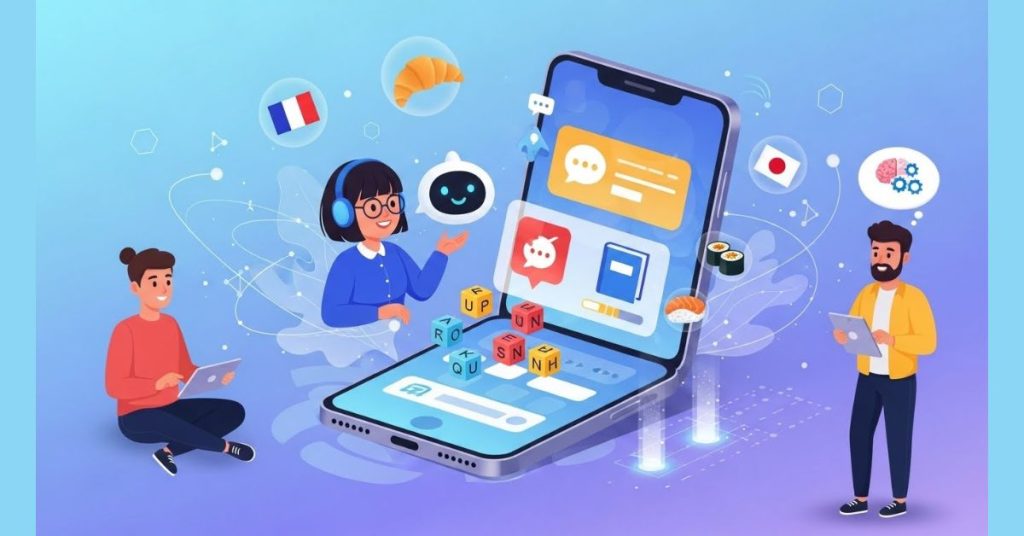
Beyond dedicated apps, generative AI and clever tech pipelines offer powerful ways to customize practice, particularly for vocabulary, which is consistently one of the key focus areas in game-based language learning research.
1. Generating Targeted Vocabulary and Texts
If you want to practice words around a specific theme (say, “football” or “medical certification”), you don’t need to manually hunt down materials.
- Create Topic-Specific Vocabulary Lists: Use AI tools to generate lists of essential words related to your topic (e.g., Polish words for football) at your specific proficiency level (e.g., B1).
- Generate Contextual Practice Texts: Request the AI to write an article (250-300 words, B1 level) on your chosen topic. Then, use that text to instantly create activities like fill-in-the-gap exercises, turning difficult words into practice gaps with a few clicks.
2. The YouTube/Translation/Wordwall Pipeline
For personalized practice derived directly from real-world media, leverage this powerful sequence:
- Identify Real-World Content: Find YouTube videos that include a downloadable transcript (not just automated subtitles).
- Capture Unknown Language: When playing the video, if you encounter a word or sentence you don’t know, copy the snippet from the transcript.
- Translate and Save: Paste the sentence into a tool like Google Translate, check the translation, and save it to your personal word/sentence list.
- Export for Gamification: Export that saved list of sentences (in both native and target language) into a spreadsheet.
- Build a Custom Game: Import the spreadsheet data directly into a platform like Wordwall to create a custom matching activity to practice the specific words you struggled with in a fun, gamified way. You can use this custom game repeatedly with new content, maximizing its value.
The Reality Check: Challenges and Best Practices for Using AI in Language Study
As a subject-matter expert, I have to be honest: AI isn’t perfect, and it comes with pitfalls you must navigate to ensure effective learning.
Focusing on the Affective Dimension
While AI is good at tracking technical performance, there is a distinct lack of focus on affective parameters—your emotional state, engagement, and self-efficacy. This is slowly changing, but designers must continue expanding beyond cold data points like “in-game performance” to understand holistic learner needs.
Actionable Insight for Learners: Don’t rely solely on the AI to recognize when you’re frustrated or anxious. If you feel overwhelmed, intentionally seek out the adaptive support features, like using the native language guide or lowering the difficulty level of the content.
Avoiding Overreliance and Technical Pitfalls
A significant concern is that overreliance on AI tools might diminish human interaction, which is a key social and communicative aspect of learning. Furthermore, technical challenges persist.
- Mind the Feedback Trap: Generic feedback, such as “Your English is good. You use simple words well,” is virtually useless and wastes practice time. Look for apps that provide granular, actionable feedback—like correcting the usage of an adverb versus an adjective—and avoid overly explicit corrections that prevent you from developing independent problem-solving skills.
- Acknowledge AI Limitations: Remember that large language models like ChatGPT, while excellent for conversational roleplay because of their near-perfect grammar, have been observed to make factual mistakes regarding specific grammar rules or word meanings. Treat them as a highly fluent friend who might sometimes give you inaccurate factual information, and always cross-reference when asking about explicit rules.
- Be Prepared for Rough Edges: Disadvantages still include technical issues, costly implementation, and sometimes coarser AI algorithms that may initially use words that are either too difficult or too basic until fully adjusted to your level.
Conclusion
We have officially moved past the era where language learning was a tedious, one-size-fits-all chore. The fusion of Artificial Intelligence and game-based learning has made personalized, immersive, and conversation-focused practice available 24/7.
Whether you’re using a simulated RPG city to conquer your fear of speaking or leveraging custom-generated lessons to prep for an exam, the crucial shift is that the learning environment now adapts to you. Now, the only thing stopping you from speaking fluently is pressing ‘Start.’
AI Language Learning Apps – FAQ
Which AI language learning apps are best for conversation practice?
Apps like Heylama, Loora AI, and TalkPal are top choices for conversational practice because they use adaptive AI to simulate real-life dialogues and provide instant feedback on fluency, grammar, and pronunciation. Heylama allows for the creation of customized role-play scenarios, making it highly flexible.
Is ChatGPT a good tool for English language learning?
Yes, ChatGPT can be excellent for conversational roleplay due to its large training data resulting in very clear English with correct grammar. However, users should be cautious about asking for specific factual information (like grammar rules or pronunciation) as it has been known to make mistakes in these areas. Some learners prefer structured apps (like Hablo or Praktika) over the open nature of ChatGPT.
What is adaptive learning, and how does AI use it?
Adaptive learning refers to systems that personalize the learning process by adjusting content, difficulty, and instructional supports in real-time based on the user’s progress, behaviors, and cognitive needs. AI accomplishes this by tracking parameters like in-game performance and help-seeking behavior, and providing adaptive dialogues and feedback.
Which AI apps are best for vocabulary building?
Heylama, Lingvist, and Duolingo are highly effective for vocabulary acquisition because they utilize spaced repetition systems, an optimized technique for long-term retention. Heylama also stands out by allowing users to add custom vocabulary lists and review them.
What are the main challenges of using AI for language learning?
Key challenges include technical issues, the risk of cognitive overload or anxiety if content is poorly adapted, and the necessity to improve AI algorithms, especially in measuring learners’ emotional states (affective perceptions). Additionally, there’s a risk of diminished human interaction if learners rely too heavily on the AI.
Do these AI apps offer features for absolute beginners?
Yes. While many apps cater to intermediate levels, apps like Duolingo and Babbel are highly accessible for beginners due to their structured curriculum. Unique AI-powered simulation games also address beginners’ needs by offering an accompanying guide who can communicate in the player’s native language to provide clarification and support.
Can I practice specific topics or create custom lessons?
Yes. Apps prioritizing flexibility, such as Heylama and TalkPal, allow users to create custom role-play scenarios and tailor vocabulary lists to their specific goals (e.g., preparing for a professional exam). Hablo also features the ability to instantly generate custom lessons based on any user-provided topic.


