

LLM Saturation Point? This is Why AI’s Knowledge Hunt is Shifting Back to Core Research
The artificial intelligence field is driven by a constant search for information and you already know that. Large language models (LLMs) like OpenAI’s ChatGPT, Google’s Gemini, and Mistral AI process and generate huge amounts of content. Using massive training data and advanced transformer models, they can answer complex questions and help create content.
The global artificial intelligence market, worth about $391 billion and expected to reach nearly $3.5 trillion by 2033 at a 31.5% CAGR, shows this rapid growth. However, a key question arises: are we nearing an LLM saturation point? In this article, I argue that relying on data quantity has limits, and AI development will shift toward foundational research and deeper understanding.
Beyond the Hype of Endless Data
The current trajectory of LLM development is largely synonymous with an insatiable hunger for information. We’ve witnessed LLMs evolve from experimental tools to integral components in various applications, offering support and generating content at an unprecedented scale. The sheer volume of training data, often measured in trillions of tokens, has been the primary driver of progress.
This data forms the bedrock of pre-training, the initial phase where models learn fundamental patterns and relationships. This relentless acquisition of information has been the defining characteristic of LLM development, propelling models like ChatGPT and Gemini to the forefront of technological advancement.
The Current AI Frontier: A Relentless Knowledge Hunt
For many, the artificial intelligence frontier means large language models (LLMs). These sophisticated systems, built upon architectures like transformer models, aim to absorb vast human-generated information to improve content generation and responses. Companies like OpenAI with ChatGPT and Google with Gemini lead this effort.
Their LLMs train on huge datasets, often trillions of tokens, showing the scale of data use. This pre-training helps models learn patterns in data. Estimates say about 300 trillion tokens of usable human text exist for LLM training. This drive for more data and computing power defines today’s LLM development.
Questioning the Path: Is There an LLM Saturation Point?
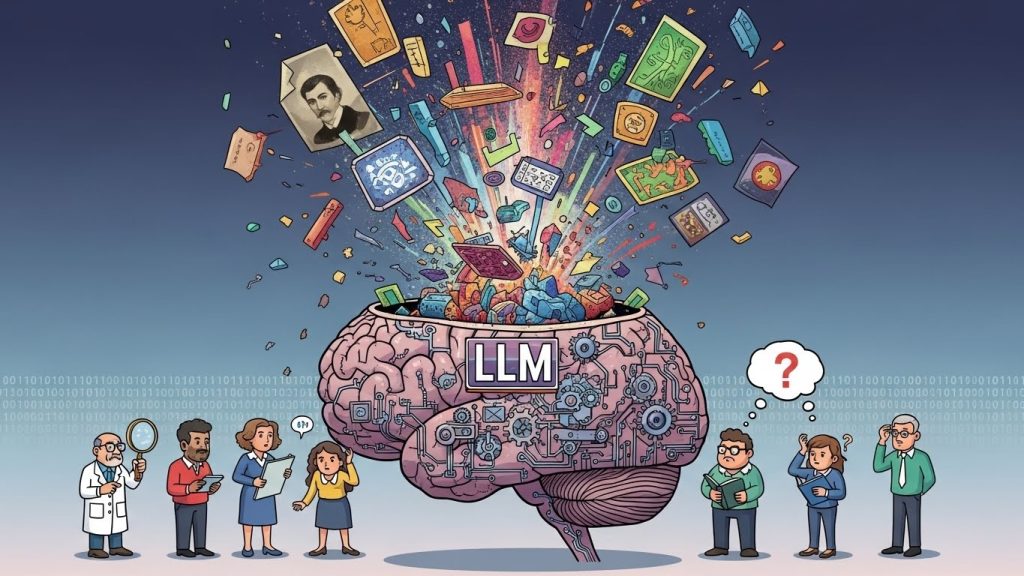
This data-driven method, though successful, has challenges. It assumes that more information always leads to better intelligence. As we feed LLMs more training data, gains may lessen while costs rise. The AI market’s growth—from $214 billion in 2024 to $1,339 billion by 2030 —shows heavy investment but also the need to grasp current limits. This “knowledge hunt” might lead to a plateau, urging us to rethink our strategies.
The Article’s Focus: A Call for Deeper Understanding
This article argues that the current focus on data quantity has limits. The future of AI development will return to foundational research and deeper cognitive understanding. We will explore current strategies for knowledge expansion and their limitations, diagnose the symptoms of approaching saturation, and champion a shift towards core AI research to build truly intelligent systems.
The Era of Knowledge Expansion: Current Strategies and Their Limits
The current era of LLM development has been largely defined by strategies focused on expanding the knowledge base of these models. This expansion primarily revolves around the sheer volume and diversity of the training data fed into increasingly sophisticated architectures.
Pre-training: The Foundation of Foundational Models
Pre-training is the first step in creating most modern pre-trained language models. Models learn from huge datasets, including much of the public internet, books, and other texts. This helps transformer models learn patterns, grammar, facts, and language nuances. Current LLM training sets may use nearly all high-quality public text, with English data reaching 40-90 trillion tokens from extensive web crawls.
If trends continue, models will train on datasets equal to all public human text by 2026-2032, or earlier if overtrained. Pre-training gives LLMs broad knowledge but compresses information heavily, retaining about 0.07 bits per token, causing loss of detail and understanding. This compression is a fundamental limitation when aiming for deep knowledge.
Retrieval Augmented Generation (RAG): Bridging Knowledge Gaps
To address pre-training limits and provide current or specific information, Retrieval Augmented Generation (RAG) adds dynamic retrieval from external knowledge bases before answering. This includes several key parts.
Data connectors take in information from different sources like databases, documents, and websites. Indexing systems organize this information. Embedding models change text into numbers for easy searching. RAG systems augment LLMs by dynamically retrieving relevant information from an external knowledge base before generating a response to a user’s request.
This involves several key components: data connectors that ingest information from various sources (e.g., databases, documents, websites), indexing mechanisms that organize this information, and embedding models that convert text into numerical representations for efficient querying.
Metadata is crucial for enriching these embeddings and enabling nuanced searches. Quality gates are implemented to filter out irrelevant or low-quality information. Hybrid search combines keyword and vector methods. RAG provides source citations for transparency and guardrails for safety. While practical for up-to-date info, RAG is a workaround that doesn’t improve the model’s reasoning or understanding, highlighting the need for deeper integration of knowledge.
You might want to read this: 10 AI Trends That Will Define 2026 (Strong Predictions)
Continual Learning and Model Editing: Adapting the Knowledge Base
Beyond RAG, other strategies like continual learning and model editing are being explored to keep LLMs updated and accurate. Continual learning aims to allow models to learn from new information incrementally without forgetting previously acquired knowledge – a significant challenge known as catastrophic forgetting.
Model editing focuses on precisely altering specific pieces of information within a trained model, akin to editing a factual error in a textbook. While these methods hold promise for adapting LLMs, they are complex and still represent active areas of research, often facing their own technical hurdles in terms of scalability and reliability.
| The AI Development Paradigm Shift | ||
|---|---|---|
| Core Focus |
Current Trajectory: The Knowledge Hunt
|
Emerging Shift: Back to Core Research
|
| Primary Driver |
Volume of Data Scaling training datasets (trillions of tokens) and compute power. |
Depth of Understanding Foundational research into cognition, reasoning, and efficient knowledge representation. |
| Core Strategy |
Expansion & Compression Pre-training on all available text; heavy compression (~0.07 bits/token). |
Efficiency & Reasoning Moving beyond pattern matching to true comprehension and logical inference. |
| Key Limitation |
Approaching Saturation Diminishing returns on more data; exhaustion of high-quality human text corpus (~300T tokens). |
Research Complexity Requires fundamental breakthroughs in AI theory, not just engineering scale. |
| Knowledge Update |
Retrieval Augmented Generation (RAG) Patches gaps by fetching external data, but doesn’t enhance core model understanding. |
Architectural Learning Building models that can natively update knowledge and learn new concepts efficiently. |
| End Goal |
Statistical Mimicry Generating plausible, human-like text based on vast seen data. |
General Intelligence Systems capable of robust reasoning, abstraction, and transfer learning. |
|
The Inflection Point:
The article argues that the diminishing returns of data scaling are pushing the field past its saturation point,
necessitating a fundamental shift from a focus on knowledge breadth to a focus on
cognitive depth and core research.
|
||
Symptoms of Saturation: The Cracks in the Knowledge Expansion Paradigm
Despite the advancements in LLM capabilities, several tell-tale signs indicate that the current paradigm of knowledge expansion is encountering limitations, suggesting an approach towards a saturation point. These symptoms manifest in the models’ behavior and the practical challenges of their deployment.
Model Collapse and Catastrophic Forgetting
One of the most significant issues arising from relentless data accumulation is the phenomenon of model collapse. As models are trained and retrained on the same or similar data, especially when that data itself is generated by earlier models, they can start to lose the diversity of their learned knowledge. This leads to a degradation of performance, where the model essentially collapses into a less capable state.
Closely related is catastrophic forgetting, where a neural network abruptly forgets previously learned information upon learning new, distinct information. This makes it challenging to update LLMs with new data without compromising their existing knowledge base, hindering their ability to adapt and stay current. This suggests that simply increasing the volume of training data without careful management can be counterproductive.
The Lingering Problem of Hallucinations and Factual Inconsistency
A common LLM problem is “hallucination“—creating plausible but false information. RAG helps by grounding answers in retrieved data, but models can still misinterpret or invent details. This is worse in specialized fields; for example, ChatGPT often gives incorrect biomedical advice.
LLMs face challenges like hallucinations in specialized domains. These errors reduce trust and limit LLM use in critical areas. The issue arises because models predict next tokens based on patterns, not truth verification. This suggests that current LLMs lack robust factual knowledge or the mechanisms to verify it, relying on surface form rather than deep understanding.
Context Window Limitations and the Illusion of “Long-Term Memory”
LLMs operate with a finite context window, which limits the amount of information they can process and consider at any given time. While context windows have expanded significantly, with models like Gemini 1.5 Pro demonstrating a long-term window of up to 1 million tokens, they still represent a bottleneck.
This prevents models from truly remembering and integrating information over extended interactions or across vast documents. This creates an illusion of “long-term memory,” where users might believe the model retains information from previous conversations, when in reality, it’s re-processing limited chunks of text with each request.
This limits AI’s ability to keep a clear, long understanding. It also limits handling very complex problems that need combining information from different sources over time. While larger context windows reduce the immediate need for RAG for document summarization or translation, they don’t fundamentally solve the issue of deep knowledge integration.
Computational Overhead and Engineering Complexity
The drive for bigger models and more training data comes with an astronomical computational cost. Training large language models like GPT-3 can use over 1,000 MWh – enough to power 130 homes for a year – while a single AI query can consume 10x more energy than a traditional web search.
This not only makes LLM development and deployment prohibitively expensive for many but also raises significant environmental concerns. Moreover, integrating and managing these complex systems, especially with add-ons like RAG, introduces considerable engineering complexity.
This complexity can hinder adoption and make it challenging to ensure robust, reliable performance in real-world scenarios, as highlighted by the need for features like role-based access, security reviews, and robust ticketing tools for enterprise deployment.
Superficiality vs. Deep Comprehension
Ultimately, many of the issues—hallucinations, context window limitations, and the need for RAG—point to a fundamental difference between pattern matching and true comprehension. LLMs excel at identifying and replicating patterns present in their training data.
They can generate fluent, coherent content that mimics human writing. However, they often lack genuine understanding, common sense reasoning, or the ability to reason causally. The progress seen in benchmarks is fast. For example, performance rose by 18.8, 48.9, and 67.3 percentage points on MMMU, GPQA, and SWE-bench in just one year.
However, this progress can hide the fact that AI is good at copying knowledge, not truly having it. This suggests that benchmark numbers can be misleading, as they may reflect mastery of superficial patterns rather than deep comprehension. Developing AI needs to go beyond advanced statistical prediction. It needs skills like abstract reasoning, causal inference, and common-sense understanding. These skills make up a true “cognitive core.”
The Call for a Cognitive Core: Shifting Back to Foundational Research

The mounting evidence of saturation and the persistent limitations of the current data-centric approach necessitate a paradigm shift in artificial intelligence development. The future lies not merely in acquiring more information but in cultivating a true “cognitive core” within AI systems. This involves a renewed emphasis on foundational research that addresses the fundamental nature of intelligence itself.
Beyond Knowledge: Building True General Intelligence
The ultimate goal of artificial intelligence is not simply to create vast repositories of knowledge, but to build systems that can reason, learn, and adapt with a level of generality akin to human intelligence.
This requires moving beyond mere statistical correlation found in massive datasets towards capabilities like abstract reasoning, causal inference, and robust common-sense understanding. While LLMs have made impressive strides in processing and generating information, they often fall short when faced with novel problems or situations that deviate from their training data.
True general intelligence implies a deeper, more flexible understanding of the world, allowing AI to tackle a wider range of problems effectively and autonomously. This shift towards foundational research and a cognitive core has important practical effects for the future of artificial intelligence development. It moves beyond focusing on the amount of information to focus on quality, understanding, and reliability.
Reinvesting in Core AI Research
This shift necessitates a significant reinvestment in core AI research. Instead of solely focusing on scaling up existing models and datasets, resources should be directed towards exploring new theoretical frameworks and experimental approaches.
This means looking beyond transformer models, which, while powerful, may have inherent limitations for deep reasoning. It involves questioning the fundamental assumptions underlying current LLM development and exploring alternative pathways that prioritize understanding over mere information retrieval.
This “deep research” aims to build AI systems that don’t just regurgitate information but can genuinely learn, adapt, and reason. This might involve exploring novel architectures like those underpinning DeepSeek V3, Kimi K2, or future iterations like Llama 4, which may prioritize efficiency and specialized reasoning.
Enhancing Internal Reasoning and Learning Mechanisms
A key area for reinvestment is in enhancing the internal reasoning and learning mechanisms of AI. This includes exploring approaches that foster common-sense reasoning, causal inference, and symbolic manipulation.
For instance, integrating reinforcement learning techniques with symbolic AI could provide a more robust framework for logical deduction. Furthermore, refining reinforcement learning paradigms could lead to AI agents that learn more effectively from experience and adapt to dynamic environments, such as the Voyager agent demonstrating emergent capabilities.
The goal is to equip AI with the ability to understand why things happen, not just that they happen, fostering a deeper form of knowledge and problem-solving. This focus on internal mechanisms could lead to more accurate classification accuracy without relying on massive, potentially corrupted, training datasets.
New Architectures and Learning Paradigms
The dominance of transformer models, while transformative, may also be a limiting factor. Future progress could hinge on developing entirely new architectures and learning paradigms that are more amenable to true understanding and reasoning.
This might involve exploring biologically inspired computational models, developing systems capable of forming and testing hypotheses, or creating AI that can learn more efficiently from fewer examples.
Such innovations are crucial for breaking through the perceived saturation point and unlocking new levels of AI capability. This could involve research into areas like representation separability to ensure distinct knowledge representations and the development of more robust truthfulness representations.
Practical Implications and Future Directions for Core AI Development
The shift towards foundational research and a cognitive core has profound practical implications for the future of artificial intelligence development, moving beyond the current focus on information quantity to emphasize quality, understanding, and reliability.
Smarter Models, Not Just Bigger Ones
The future of LLM development should be about creating smarter models, not just bigger ones. This implies a focus on efficiency and effectiveness rather than brute force scaling. Advances in core research can lead to models that achieve superior performance with smaller parameter counts and less training data, making them more accessible, sustainable, and less computationally intensive.
This pursuit of “smarter” AI means developing models that can reason more deeply, adapt more readily, and require less external augmentation to perform complex tasks. This could also lead to more effective multilingual language models that achieve deeper understanding across languages rather than just surface-level translation.
Interpretability and Trust: The Pillars of Adoption
A significant barrier to the widespread adoption of advanced AI is the lack of interpretability and trust. Many current LLMs operate as “black boxes,” making it difficult to understand their decision-making processes.
By focusing on core research that enhances internal reasoning and learning mechanisms, we can move towards more interpretable AI systems. Understanding how an AI arrives at a conclusion is crucial for building trust, especially in critical applications like healthcare, finance, and autonomous systems.
This increased transparency will be a key driver of user confidence and broader AI integration. This is crucial for applications like biomedical foundation models, where accuracy and explainability are paramount.
Beyond Reactive Support: Proactive Intelligence
The current reliance on LLMs often focuses on reactive support—answering questions, generating content on demand. A shift towards core research promises to unlock proactive intelligence. AI systems that possess deeper reasoning capabilities can anticipate needs, identify potential problems before they arise, and offer insights that go beyond mere information retrieval. Imagine
AI that can find risks in a complex project plan before they happen. It can suggest new solutions to scientific problems. It can also help make strategic decisions by combining lots of information and predicting future trends. This moves beyond simply writing code based on prompts to actively contributing to the development process.
The Long-Term Vision: Sustainable and Ethical AI
Ultimately, a focus on foundational research and a cognitive core aligns with the long-term vision of sustainable and ethical AI. By reducing the reliance on massive data appetites and computational resources, AI development can become more environmentally responsible. Furthermore, by prioritizing deep understanding and interpretability, we can mitigate risks associated with AI, such as bias and unintended consequences.
The pursuit of true intelligence, grounded in robust research, offers a pathway to AI that is not only powerful but also beneficial and trustworthy for society. This also aligns with the development of advanced AI assistants capable of translating text and summarizing text with a higher degree of nuance and accuracy.
Reaching a Crossroads: Data Quantity vs. Core Quality
The artificial intelligence community finds itself at a critical crossroads. The prevailing strategy of aggressively pursuing ever-larger datasets and models, while yielding impressive results in content generation and information retrieval, is showing signs of approaching a saturation point.
Symptoms like model collapse, persistent hallucinations, and the reliance on complex workarounds like Retrieval Augmented Generation (RAG) highlight the limitations of a purely data-driven approach. The sheer scale of training data required—approaching the limits of publicly available text, with estimates suggesting potential exhaustion between 2026 and 2032 —underscores the unsustainability of this path.
The immense computational overhead and engineering complexity associated with training models on such vast datasets raise serious questions about the future scalability and environmental impact of current LLM development.
The Promise of Deep Research
The next frontier for artificial intelligence lies not in the quantity of information ingested, but in the depth of understanding achieved. A strategic shift back to core AI research is imperative. This means reinvesting in foundational studies that explore novel architectures, enhance internal reasoning mechanisms, and foster genuine comprehension rather than mere pattern matching.
The development of AI requires moving beyond sophisticated statistical prediction towards capabilities like abstract reasoning, causal inference, and common-sense understanding—elements that constitute a true “cognitive core.”
This focus promises smarter, more efficient, and more reliable AI systems, moving beyond reactive support to proactive intelligence, and laying the groundwork for AI that is truly trustworthy. This shift also means that multilingual capabilities will be built on deeper semantic understanding rather than just larger multilingual corpora.
A Call to Action for the AI Community
The immense global market growth for AI, projected to reach nearly $3.5 trillion by 2033, signifies the transformative potential of this field. However, to realize this potential sustainably and ethically, a collective reorientation is needed.
The AI community must embrace a vision that prioritizes fundamental scientific inquiry and cognitive modeling over the relentless pursuit of bigger models and more data. By focusing on enhancing internal learning mechanisms and developing new paradigms, we can unlock AI capabilities that are not only more powerful but also more interpretable, robust, and aligned with human values.
The path forward requires a bold commitment to deep research, paving the way for an era of truly intelligent, rather than merely knowledgeable, artificial intelligence. This includes exploring advancements in models like DeepSeek V3, Kimi K2, and Llama 4 not just for scale, but for their potential to embody these principles of deeper understanding and efficiency.
Conclusion
The relentless pursuit of more data has propelled large language models to remarkable heights, enabling capabilities from writing code to translating text. However, the current paradigm of scaling up training data and models is encountering significant limitations, evidenced by model collapse, catastrophic forgetting, hallucinations, and immense computational costs.
We are approaching an LLM saturation point where the gains from sheer data accumulation are diminishing. The future of artificial intelligence development hinges on a strategic shift back to core research, focusing on building a robust “cognitive core.”
This involves reinvesting in novel architectures, enhancing internal reasoning and learning mechanisms, and prioritizing deep understanding over superficial pattern matching. Embracing this shift will lead to smarter, more efficient, interpretable, and ultimately more trustworthy AI systems, moving us closer to true general intelligence and unlocking AI’s full, sustainable potential.
FAQ
Why is the era of LLM knowledge expansion coming to an end?
The era of LLM knowledge expansion is approaching its saturation point due to several factors, including the diminishing returns of simply scaling up models with more data and parameters. As models grow larger, the computational costs and energy consumption become unsustainable.
Furthermore, these large models often lack true understanding, relying instead on pattern recognition and statistical predictions. This has highlighted the need for AI development to focus on more efficient, meaningful, and sustainable growth through deep research into cognitive capabilities.
What makes deep research different from current LLM training practices?
Deep research focuses on the exploration of foundational AI principles rather than the brute-force scaling of existing models. It involves investigating novel architectures, understanding the underlying mechanisms of intelligence, and developing AI that can reason, learn, and adapt with a deeper comprehension of the world.
Current LLM training practices, in contrast, primarily focus on ingesting massive amounts of training data to improve statistical prediction and pattern matching, often leading to issues like hallucinations and superficial knowledge.
How does Retrieval Augmented Generation (RAG) fit into this shift?
Retrieval augmented generation (RAG) is a valuable tool for providing LLMs with up-to-date or domain-specific information, acting as a bridge over knowledge gaps. However, it is largely a workaround for the limitations of internal knowledge representation.
As AI development shifts towards deeper understanding and more robust internal knowledge, the reliance on complex RAG systems may decrease for general queries, though they will likely remain crucial for accessing proprietary or highly dynamic information.
What are the key challenges in building true general intelligence?
Building true general intelligence requires moving beyond statistical pattern matching and into areas like abstract reasoning, causal inference, common-sense understanding, and robust learning mechanisms. Challenges include developing AI that can learn efficiently from less data, adapt to novel situations without catastrophic forgetting, and possess a degree of self-awareness or interpretability in its decision-making processes.
How will the focus on core research impact the development of specialized AI, like biomedical foundation models?
A shift towards core research will significantly benefit specialized AI. Instead of generic LLMs trying to learn niche domain knowledge through vast, uncurated datasets, future specialized models will be built on more robust foundational principles.
This will allow for more accurate, reliable, and interpretable AI in fields like medicine, finance, and scientific discovery, where deep domain knowledge and factual accuracy are paramount. This will also improve the ability to process biomedical literature more effectively.
What are the potential benefits of developing smarter, not just bigger, AI models?
Smarter models offer numerous benefits, including reduced computational costs, lower energy consumption, increased accessibility, and improved efficiency.
They are more likely to possess genuine understanding and reasoning capabilities rather than superficial fluency. This leads to more reliable AI assistants, better tools for writing code, and more accurate translating text and summarizing text, all while being more sustainable.
What is “model collapse” and why is it a problem for LLMs?
Model collapse occurs when an LLM, through repeated training or training on data generated by other LLMs, begins to lose the diversity of its knowledge and performance degrades. It essentially becomes a less capable, “collapsed” version of itself. This is a significant problem because it indicates that simply adding more training data isn’t always beneficial and can actively harm the model’s capabilities, limiting knowledge expansion.