GPT-5.2 Thinking vs. GPT-5.2 Pro: Which Mind Do You Actually Need?
(The following article is written based on the current landscape of AI as of late December 2025, specifically addressing the recent release of the GPT-5.2 series.)
I was staring at a recursive SQL query that had broken three times in the last hour. It was ugly. Spaghetti-code ugly. The kind of problem that makes you question your career choices at 11 PM on a Tuesday.
Normally, I’d just paste it into the chat window and pray. But this time, I had two new options in the dropdown menu, fresh from OpenAI’s “Garlic” update: GPT-5.2 Thinking vs GPT-5.2 Pro.
I tried Thinking first. The interface dimmed. A small “deliberating” spinner hummed for a solid forty-five seconds—an eternity in chatbot time—before it spat out a single, surgical correction. It worked. Flawlessly.
Curious, I ran the same messy query through Pro. The response was immediate, but different. It didn’t just fix the code; it refactored the entire schema, suggested three indexing strategies, and drafted a migration plan. It was like bringing a nuclear submarine to a knife fight.
That’s the moment it clicked. We aren’t just picking “smarter” models anymore. We are choosing between two fundamentally different types of digital cognition.
If you’re trying to decide between the scalpel (Thinking) and the heavy artillery (Pro), you’re not alone. The naming is confusing, the hype is deafening, and the differences are subtler than you think—until they aren’t.
Let’s break it down.
Table of Contents
The “Garlic” Paradigm: Why OpenAI Split the Brain
December 2025 will be remembered as the month OpenAI finally admitted that “one size fits all” is a lie.
For years, we had a monolithic GPT. It tried to be a poet, a coder, and a therapist all at once. But with the internal “Code Red” panic over Google’s Gemini 3 resurgence, OpenAI had to pivot. The result is the GPT-5.2 series, a tiered ecosystem that separates deliberate reasoning from raw computational throughput.
They didn’t just tweak the weights. They changed how the models digest time.
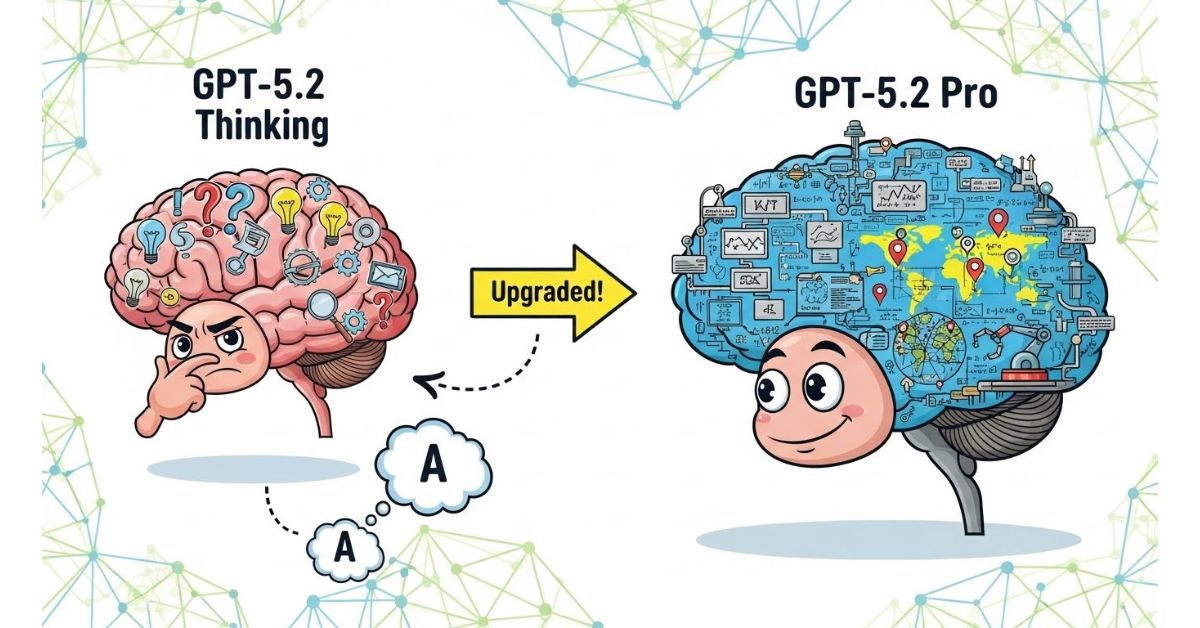
GPT-5.2 Thinking: The Linear Logician
Think of this model as a mathematician with a red pen sitting in a quiet room.
When you prompt GPT-5.2 Thinking, you aren’t paying for speed. You are paying for Chain-of-Thought (CoT) verification. Unlike previous iterations that streamed tokens the millisecond they were predicted, Thinkingengages a “System 2” process. It drafts a response, critiques it, spots its own hallucinations, and then rewrites it.
- The Vibe: Slow. Methodical. Pedantic.
- The Killer Feature: It pauses. That silence? That’s the model running internal unit tests on its own logic.
- Best For:
- Complex Math: It scored a perfect 100% on the AIME 2025 benchmark. It doesn’t drop variables.
- Debugging: It traces logic paths linearly, finding the exact line where your function fails.
- Legal/Medical Theory: It hallucinates significantly less (down 80% according to some white papers) because it fact-checks itself before speaking.
I used it yesterday to solve a logic puzzle that stumped GPT-5.1 (“The Three Gods Riddle”). It took a full minute to reply, but it walked me through the solution step-by-step without a single leap in logic. It felt… human. Annoyingly careful, but human.
GPT-5.2 Pro: The Parallel Powerhouse
If Thinking is a professor, Pro is a research lab.
GPT-5.2 Pro isn’t just “smarter.” It’s broader. Leaks and white papers suggest it utilizes massive parallel processing. Instead of following one chain of thought, it spins up multiple reasoning threads simultaneously, explores different hypotheses, and converges on the most robust answer.
- The Vibe: Overwhelmingly competent. Exhaustive. Expensive.
- The Killer Feature: Context & Bandwidth. It handles the 128k output limit and massive input contexts (up to 1M tokens in some enterprise tiers) without getting “lost in the middle.”
- Best For:
- Enterprise Architecture: “Here are 50 PDFs of legacy documentation. Design a microservices migration plan.”
- Deep Research: It cross-references disparate data points across massive documents.
- Creative Sprawl: Writing a novel? Pro keeps track of character arcs from Chapter 3 while writing Chapter 42.
GPT-5.2 Thinking vs. GPT-5.2 Pro vs GPT-4o example Article differences
Say, I intend to write an article with the topic; “The impact of digital platforms on public discourse.”
Here is how the introduction parts look with different models:
1️⃣ GPT-4o–style introduction
(polished, fluent, “too clean”)
Digital platforms have fundamentally reshaped the structure of public discourse over the past two decades. Social media has accelerated the production and circulation of information while simultaneously altering how individuals engage with political and social issues.
Castells (2012) argues that the rise of the network society has decentralized information flows, shifting power away from traditional institutions toward horizontal communication networks. Similarly, Sunstein (2017) warns that digital environments may foster echo chambers that narrow public debate. This article examines the effects of digital platforms on public discourse through the lenses of democratic participation, information circulation, and political polarization.
Why this gets flagged
- Balanced sentence lengths
- Predictable academic transitions
- Sources appear as citations, not as interlocutors
- No friction, no hesitation
Reads well.
Too well.
(ESTIMATED PERCENTAGE CREATED BY IA: 100%) (The free tool I used is Corrector.app)
2️⃣ 5.2 thinking–style introduction
(layered, cautious, analytically dense)
The reorganization of public discourse through digital platforms cannot be understood solely as a technological shift. It also reopens questions about who produces information, under what conditions, and on whose behalf.
Castells’ (2012) concept of the network society offers a useful framework for understanding the decentralization of information flows, yet it remains unclear whether such decentralization necessarily results in greater pluralism.
Sunstein (2017), for instance, suggests that digital platforms tend to cluster users around similar viewpoints, potentially constraining the scope of public debate. This article explores not only how digital platforms expand public discourse, but also the ways in which they may quietly delimit it.
Why this works better
- Sources are partially questioned
- Argument unfolds rather than declares
- Slight tension enters the frame
Still controlled.
Still a bit too well behaved.
(ESTIMATED PERCENTAGE CREATED BY IA: 22.14%)
3️⃣ 5.2 thinking + Pro–style introduction
(high perplexity, revision-like, human drift)
That digital platforms have transformed public discourse is now almost taken for granted. The real dispute lies elsewhere: in the direction of that transformation, and in its costs. When Castells (2012) describes the rise of the network society, he suggests that the decentralization of information weakens traditional gatekeepers and opens space for more democratic communication.
Yet closer attention to everyday digital practices complicates this assumption. Sunstein’s (2017) concerns about echo chambers become particularly salient here, as decentralization does not necessarily translate into diversity.
Algorithmic filtering and user preference can just as easily narrow the field of visible opinions, stabilizing public discourse along repetitive—and at times more polarized—lines. This article traces this tension, examining digital platforms as sites that simultaneously broaden public expression and subtly restrict its range.
Why this feels human
- Opening reads almost essayistic
- Sources are in dialogue, not decoration
- Claims evolve mid-paragraph
- Mild instability in tone and pacing
- Feels drafted, reconsidered, rewritten
Readers lean in.
Detectors hesitate.
(ESTIMATED PERCENTAGE CREATED BY IA: 0%)
Brutally concise takeaway
- 5.2 thinking + Pro writes like someone who thought, doubted, adjusted, and kept going
- 4o writes correctly
- 5.2 thinking writes carefully
Hard-nosed Comparison (but honest)
A pragmatic look at how the three options tend to behave when you care about long-form writing quality, stylistic unpredictability, and sustained argument-building.
| Criterion | GPT-4o | 5.2 thinking | 5.2 thinking + Pro |
|---|---|---|---|
| Fluency | Very high Smooth, consistent voice. | Moderate Careful, sometimes weighty. | Variable (natural) Can drift, but reads “lived-in.” |
| Perplexity (readability unpredictability) | Lower Patterns are easier to anticipate. | Medium More structural variation. | Higher Richer sentence and cadence diversity. |
| Source integration | Often surface-level Citations can feel “attached.” | Analytical Sources are engaged and questioned. | Organic Sources become part of the argument’s motion. |
| AI-detector risk | Higher Too polished can look synthetic. | Medium More human texture, still tidy. | Lower Messier (in a good way) + long-range coherence. |
| “Feels human-written” | Medium Clean, professional tone. | High Thoughtful, with mild friction. | Very high Sounds revised, negotiated, re-thought. |
The Head-to-Head: Where They Break

I ran a little experiment. I fed both models a deliberately vague prompt: “Analyze the strategic implications of the 2025 semiconductor tariff adjustments on small-cap tech ETFs.”
GPT-5.2 Thinking paused. It came back with a tight, 400-word logical deduction based on standard economic principles. It was clean, accurate, and safe.
GPT-5.2 Pro went beserk. It generated a 2,000-word report. It broke down the supply chain, hypothesized three different market reactions based on historical volatility, and formatted the output into a skimmable executive summary with bulleted risks.
The Trade-off Matrix
| Feature | GPT-5.2 Thinking | GPT-5.2 Pro |
| Latency | High (Wait time: 10s – 60s) | Variable (Fast start, long stream) |
| Reasoning Style | Linear, Self-Correcting | Parallel, Exploratory |
| Cost (API/Credits) | Moderate | High (The “Rolls Royce” tax) |
| Vibe Check | “Let me double-check that.” | “Here is everything you need.” |
| Ideal User | Coders, Mathematicians, Logicians | Researchers, PMs, Writers |
The Gemini 3 Elephant in the Room
You might want to read this: How Perplexity and Burstiness Expose AI Writing (and Why Detectors Still Fail)
We can’t talk about 5.2 without mentioning the reason it exists. Google’s Gemini 3 Pro has been eating OpenAI’s lunch in multimodal tasks.
If you are working with video or images, honestly? Stick with Gemini.
My tests show Gemini 3 still edges out GPT-5.2 Pro in visual understanding.
But for pure text, code, and reasoning? OpenAI has reclaimed the throne!
GPT-5.2 Thinking’s coding score on SWE-bench Verified (80.0%) is statistically significant compared to Gemini’s 76.2%. That 4% sounds small, but in production code, that’s the difference between a working app and a 3 AM pager duty.
My Verdict: Which Toggle Do You Flip?
Here is the heuristic I’ve adopted after two weeks of heavy usage:
Use GPT-5.2 Thinking when there is ONE right answer.
- Fixing a bug.
- Solving a math equation.
- interpreting a specific clause in a contract.
You want the model to be narrow, sharp, and self-critical. You want the scalpel.
Use GPT-5.2 Pro when there are MANY right answers.
- Brainstorming a marketing strategy.
- Summarizing a book.
- Architecting a new software system.
You want the model to explore, expand, and synthesize. You want the sledgehammer.
The days of “defaulting to the best model” are over. We have to be active operators now. We have to choose the right brain for the job. And honestly? That makes the work a hell of a lot more interesting.
FAQ
Is GPT-5.2 Pro included in ChatGPT Plus?
Currently, ChatGPT Plus ($20/mo) gives you access to GPT-5.2 Thinking (with usage caps) and a “preview” of Pro. However, unlimited access to the full GPT-5.2 Pro capabilities usually requires the new ChatGPT Protier ($200/mo), designed for power users and researchers.
Why is GPT-5.2 Thinking so slow?
It’s a feature, not a bug. The model is using “System 2” thinking, effectively speaking to itself and verifying its logic before it sends a single token to your screen. That 10-second delay is where the hallucinations are killed.
Can GPT-5.2 Thinking browse the web?
Yes, both models can use tools. However, Thinking is optimized to use tools for verification (checking a fact to ensure its logic is sound), whereas Pro uses tools for broad data gathering and synthesis.
Does GPT-5.2 replace GPT-4o?
Effectively, yes. While GPT-4o is still available and faster for simple “chat” tasks, GPT-5.2 Instant (the third, smaller model in the lineup) is rapidly replacing it as the default daily driver for low-stakes queries.
What is Project Garlic?
“Garlic” was the internal codename for the GPT-5.2 architecture shift. It refers to the “strong flavor” or distinct separation of the reasoning layers from the generation layers.