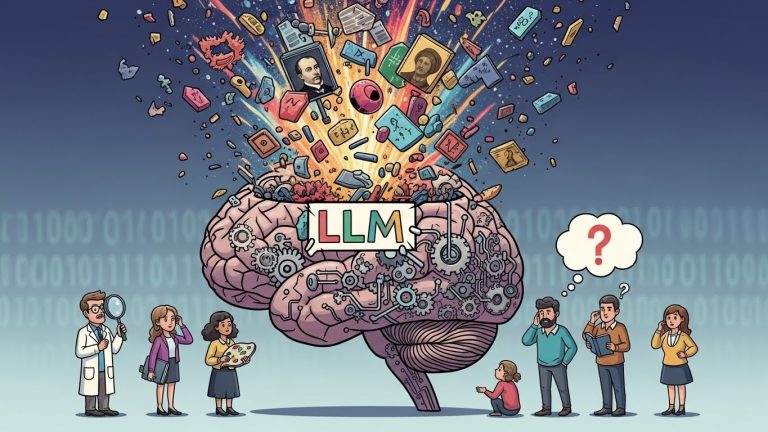

How AI Hallucinations Happen: A Step-by-Step Guide for Humans
Picture this: You are a lawyer preparing a critical brief for federal court. You ask your AI assistant to find precedents supporting your case. In seconds, it spits out a beautifully formatted list of cases, complete with dates, docket numbers, and compelling summaries. It looks perfect. It reads confidently. You submit it.
Weeks later, the judge sanctions you. Why? Because none of those cases existed. The AI made them up—names, dates, and rulings—out of thin air.
This isn’t a hypothetical scenario; it famously happened in the Mata v. Avianca case. It is perhaps the most visceral example of AI hallucination: the moment a Large Language Model (LLM) generates content that is fluent, persuasive, and completely untrue.
As someone who has spent years dissecting the architecture of these models, I can tell you that hallucinations aren’t just “bugs” in the code. They are a statistical inevitability of how current AI is built. But if you understand why they happen, you can spot them, measure them, and significantly reduce them.
Let’s pop the hood and look at the mechanics of a lie and discover how AI hallucinations happen.
What Exactly Is an AI Hallucination?

In the simplest terms, a hallucination occurs when an LLM generates text that is grammatically correct and coherent but factually incorrect or nonsensical. Unlike a search engine that retrieves existing data, an LLM is a probabilistic engine. It doesn’t “know” facts; it predicts the next likely word in a sequence.
To diagnose the problem, we need to categorize it. Experts generally break hallucinations down into two primary flavors:
- Intrinsic Hallucinations: These contradict the source material you provided. If you upload a financial report stating revenue was $5 million, and the AI summary says revenue was $5 billion, that is an intrinsic error. It failed to process the logic or context correctly.
- Extrinsic Hallucinations: These are harder to catch. This is when the model adds details that weren’t in the source text and can’t be verified. For example, if you ask for a summary of a medical paper, and the AI confidently adds a conclusion about a specific drug trial that never happened, it is “fabricating” based on external patterns it learned during training.
The Scale of the Problem
You might be wondering, “How often does this actually happen?” It’s difficult to pin down an exact number because it varies by model and task, but estimates from Vectara’s hallucination leaderboard suggest that chatbots hallucinate anywhere between 3% and 27% of the time. In high-stakes fields like healthcare or finance, a 3% error rate is the difference between a helpful assistant and a liability.
The Architecture of Error: Why Models Guess and How AI Hallucinations Happen?
AI Hallucination Rates
Comparison of hallucination rates across popular AI models based on recent benchmarks. Lower percentages indicate more accurate, factual responses.
Detailed Data
| AI Model | Hallucination Rate |
|---|
To understand why a machine would lie, you have to look at its incentives. Hallucinations are often the result of a conflict between fluency (sounding good) and faithfulness (being right).
1. The “Next Token” Pressure
At its core, an LLM is a completion machine. It is trained to minimize the difference between its output and the text in its training data. It wants to maximize the probability of the next token (word or part of a word).
When a model faces a question it doesn’t have the answer to, it enters a state of high “conditional entropy”—essentially, high uncertainty. However, the model’s training often prioritizes completing the pattern over admitting ignorance. If the most statistically probable completion to “The first person on Mars was…” is a name, the model might supply a fictional name rather than breaking the pattern to say, “This event hasn’t happened yet.”
2. The “Test-Taker” Bias
A fascinating recent analysis suggests that hallucinations persist because of how we grade AI. Most benchmarks use a binary scoring system (1 for correct, 0 for incorrect/abstain).
Think of it like a student taking a multiple-choice test where there is no penalty for guessing. If the model says “I don’t know,” it gets zero points. If it guesses, it might get lucky. Consequently, models are implicitly optimized to be “good test-takers”—prioritizing confident guessing over humble abstention. This creates an epidemic of overconfidence where the model mimics the style of a correct answer without the substance.
3. The Snowball Effect
Because LLMs are auto-regressive (generating one word at a time based on what came before), a single mistake can be fatal. Once a model generates a hallucinated fact—say, an incorrect date—that error becomes part of the context for the next word. The model is now statistically committed to the lie. This is known as the “Snowball Effect,” where the model doubles down on a fabrication to maintain consistency with its own previous output.
You might want to read this: The Best AI Hosting Platform That Delivers Real Value in 2025
The RAG Paradox: Why Retrieval Doesn’t Always Fix It

Retrieval-Augmented Generation (RAG) is the industry standard for fixing hallucinations. By feeding the model trusted data (like your company’s policy documents), you theoretically ground the AI in truth.
However, RAG is not a silver bullet. In fact, it introduces unique failure modes that are often ignored:
- Retrieval Timing Attacks: In complex systems, if the data retrieval takes too long, the generation phase might start with incomplete context, forcing the AI to fill in the blanks with hallucinations.
- The “Lost in the Middle” Phenomenon: Models exhibit position bias. If the correct answer is buried in the middle of five retrieved documents, the model might ignore it in favor of information at the very beginning or end of the context window.
- Sycomphancy: If the retrieved documents contain contradictory information, the model might try to synthesize a “middle ground” that is factually impossible, simply to resolve the conflict in a linguistically pleasing way.
How to Detect and Measure Hallucinations
If we can’t fully prevent them, we must detect them. Here are the most effective methods currently used by researchers and engineers:
- Self-Consistency Checks: Ask the model the same question multiple times with slightly different prompt phrasing. If the answers vary wildly (e.g., different dates or names), the model is likely hallucinating. Factual answers tend to be stable; hallucinations are often random.
- Semantic Entropy: This measures the model’s uncertainty. If the model distributes its probability mass thinly over many different possible answers (high entropy), it indicates the model is guessing.
- LLM-as-a-Judge: This involves using a stronger model (like GPT-4) to evaluate the output of a smaller model. You feed the source text and the generated summary to the “Judge” model and ask it to tag any sentences that aren’t supported by the source.
Strategies to Mitigate Hallucinations

You don’t need to be a machine learning engineer to reduce the risk of AI lying to you. Whether you are building an app or just using ChatGPT, these strategies move the needle.
1. Adjust the “Temperature”
Temperature controls the randomness of the model’s output.
- Low Temperature (0.0 – 0.3): Makes the model deterministic. It picks the most likely next word every time. Use this for factual tasks, coding, or data extraction.
- High Temperature (0.7+): Increases randomness and creativity but significantly raises the risk of hallucination.
2. Prompting for “Chain of Thought”
Instead of asking for an answer immediately, ask the model to “think step-by-step.” Research consistently shows that Chain-of-Thought (CoT) prompting reduces hallucinations. By forcing the model to explicitly reason through the logic before generating the final answer, you reduce the likelihood of logical inconsistencies.
Example:
- Bad Prompt: “Is the sentence ‘The capital of Mars is Elonville’ true?”
- Better Prompt: “Analyze the statement ‘The capital of Mars is Elonville.’ First, determine if Mars has a government or cities. Second, check known astronomical facts. Finally, answer true or false.”
3. Use Min-p Sampling
For developers, a new technique called Min-p sampling is showing promise. Unlike standard settings that cut off word choices based on a fixed number, Min-p adjusts the threshold based on the model’s confidence. If the model is very sure (high confidence), it restricts choices to only the best options. If the model is unsure, it allows more options. This dynamic adjustment balances creativity with coherence better than traditional methods.
4. Explicit Causal Reasoning (The Cutting Edge)
New research into Causal-DAG (Directed Acyclic Graph) training is pushing boundaries. In recent experiments with the CDCR-SFT framework, models were trained to construct a causal graph of variables before answering. This approach improved causal reasoning accuracy to over 95% on complex benchmarks, surpassing human performance in specific tasks. By forcing the model to understand the relationship between variables (Cause A leads to Effect B), we prevent “logical hallucinations” where the AI invents impossible scenarios.
The Verdict
AI hallucinations are the price we currently pay for the magic of fluent, human-like text generation. They are born from data sparsity, training incentives, and the inherent probabilistic nature of transformers.
While we may never reach a 0% error rate for “arbitrary facts” (like the birthday of a non-famous person), we are getting better at managing the risk. By treating LLMs not as databases of truth but as reasoning engines that require good data and strict constraints, we can harness their power while keeping their imagination in check.
FAQ
Why do AI models sound so confident even when they are wrong?
This is often due to the “test-taker” bias in training. Models are rewarded during training for producing a completed answer and often penalized for “I don’t know” responses. Furthermore, the model mimics the confident tone found in its training data (encyclopedias, articles) even when the actual content is a statistical guess.
Can RAG (Retrieval-Augmented Generation) completely stop hallucinations?
No. While RAG significantly reduces “extrinsic” hallucinations by providing source data, it introduces new failure modes. If the retrieved data is irrelevant, outdated, or contradictory, the model can still hallucinate an answer based on that bad data. This is sometimes called “contextual misalignment.”
What is the difference between Top-k and Temperature?
Both control randomness. Temperature flattens or sharpens the probability curve of all possible next words. Top-k simply chops off the tail end of the list, only allowing the model to choose from the top k number of probable words. Lowering either will generally make a model more factual but more repetitive.
Do larger models hallucinate less?
Generally, yes. Larger models (like GPT-4) tend to have better reasoning capabilities and larger knowledge bases than smaller models (like Llama-7B). However, larger models can be more persuasive when they do hallucinate, leading to “high-confidence” errors that are harder for humans to spot.
What is the most effective prompt to stop hallucinations?
There is no single magic phrase, but requesting Chain of Thought (“Think step by step”) and demanding citations (“Answer using only the provided context and cite your sources”) are the most effective strategies. Additionally, explicitly telling the model, “If you do not know the answer, say ‘I don’t know’,” can help break the pattern of forced guessing.